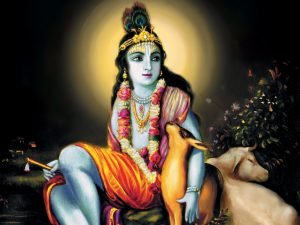
Food is the life of all beings, and all food comes from rain above. Sacrifice brings the rain from heaven, and sacrifice is sacred action.
Bhagavad-gītā – Penguin Classics (3:12)
Bhagavad-gītā
The Bhagavad-gītā is about focused engagement, providing a wide-ranging comprehension of yoga’s principles and processes. Each chapter offers a particular approach to the overall message of spiritual engagement (yoga). It is both analytical and synthetic in character – opening out the subject in careful scrutiny and drawing together apparently diffuse ideas into a unified (yoga) vision.
Here we will study the Bhagavad-gītā chapter by chapter, both to gain a sense of the essential contours of the work, and to call attention to the varied ways in which yoga is represented throughout the work. Each chapter is wrapped into a course with an overview by Dr Kenneth Valpey of Oxford Centre for Hindu Studies and purports and lectures by A. C. Bhaktivedanta Swami Prabhupada, widely regarded as the foremost Vedic scholar, translator, and teacher of the modern era.
As we will see, while the Gītā has a definite linear progression from Chapter 1 through Chapter 18, it is also a “song” (gītā), complete with refrains and a rich, varied rhythm of expanding and heightening vision of cosmic order and consciousness, and of the hope and possibility for human individual and collective well-being.
You have a right to perform your prescribed duty, but you are not entitled to the fruits of action. … Any attachment, positive or negative, is cause for bondage.
Bhagavad-gītā – As It Is (2:47 & Purport)
Acknowledgment
– A mighty thank you to the awesome folks at vedabase.io for bringing Vedic wisdom to the web. Click here to donate.
– Another mighty thank you to the awesome folks at Bhaktivedanta Vedic Library for turning Vedic wisdom into audiobooks. Click here to donate.
– And the mightiest thank you to the awesome folks at Bhaktivedanta Archives for preserving ancient Vedic wisdom into this age. Click here to donate.
Content used with permission of © The Bhaktivedanta Book Trust International, Inc. All rights reserved. (to be confirmed)
Karma-yoga
In the first six chapters of the Bhagavad-gītā, the living entity is described as nonmaterial spirit soul capable of elevating to self-realization by different types of yogas. The knower of the body (the living entity) and the position by which the Supreme Lord can be understood are described. Stress is given to devotional service: yoginām api sarveṣāṁ. “Of all … yogīs or transcendentalists, one who always thinks of Me within himself is best.” (see purports in BG 7. 1, BG 13. 1-2 and BG 18. 1)
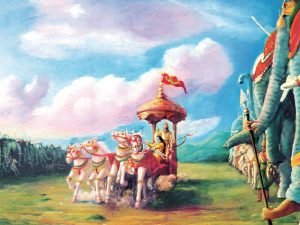
BG 1 | Arjuna’s Dejection (arjuna-viṣāda-yoga)

BG 2 | Analysis (sāṅkhya-yoga)
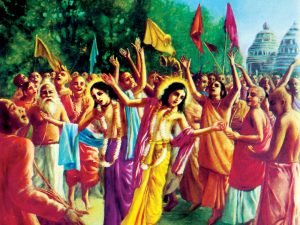
BG 3 | Action (karma-yoga)
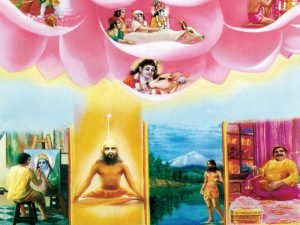
BG 4 | Knowledge (jñāna-yoga)
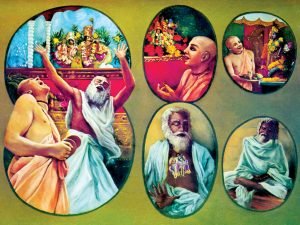
BG 5 | Renunciation (sannyāsa-yoga)

BG 6 | Meditation (dhyana-yoga)
Bhakti-yoga
Chapters six through twelve are the essence of the Bhagavad-gītā. The first six and the last six chapters are like coverings for the middle six chapters. Here the Supreme Personality of Godhead and the relationship between the individual soul and the Supersoul in regard to devotional service are described. The superior position of the Supreme Personality of Godhead and the subordinate position of the individual soul are definitely defined in these chapters. The living entities are subordinate under all circumstances, but in their forgetfulness they are suffering. When enlightened by pious activities, they approach the Supreme Lord in different capacities as the distressed, those in want of money, the inquisitive, and those in search of knowledge. (see purports in BG 8. 28 and BG 13. 1-2)
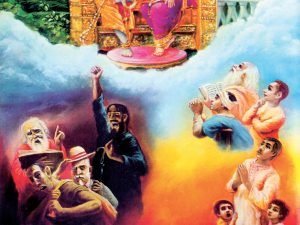
BG 7 | Wisdom (vijnana-yoga)
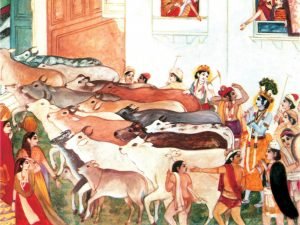
BG 8 | Liberating Spirit (tāraka-brahma-yoga)
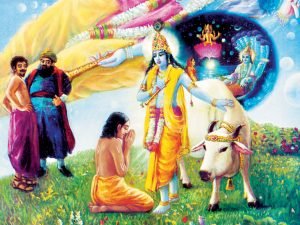
BG 9 | Royal Knowledge (rāja-vidyā-rāja-guhya-yoga)
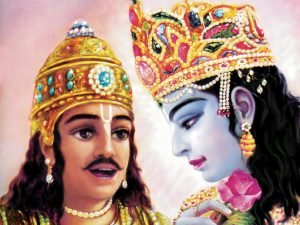
BG 10 | Excellence (vibhūti-yoga)
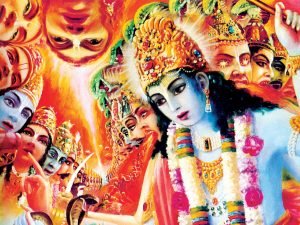
BG 11 | Cosmic Form (viśva-rūpa-darśana-yoga)
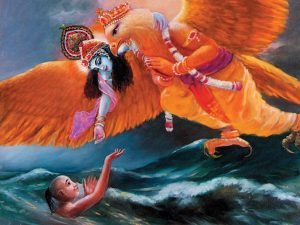
BG 12 | Devotion (bhakti-yoga)
Jñāna-yoga
In the last six chapters, knowledge, renunciation, the activities of material nature and transcendental nature, and devotional service are described. All acts should be performed in conjunction with the Supreme Lord, represented by the words oṁ tat sat, which indicate Viṣṇu, the Supreme Person. Here it is shown that devotional service, and nothing else, is the ultimate purpose of life. This is being established by citing past ācāryas and the Brahma-sūtra, the Vedānta-sūtra. In every scripture, every Veda, devotional service is the objective. That is explained in Bhagavad-gītā. (see purport in BG 18. 1)
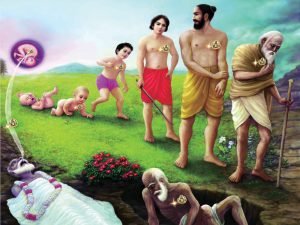
BG 13 | Matter vs. Spirit (prakṛti-puruṣa-viveka-yoga)
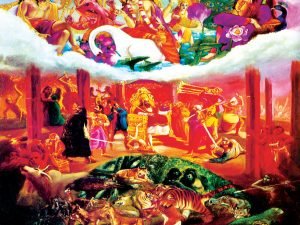
BG 14 | Threefold Modalities (guṇa-traya-vibhāga-yoga)
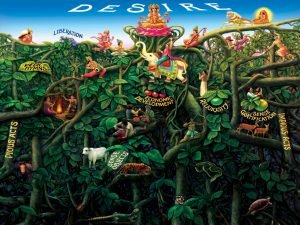
BG 15 | Ultimate Person (puru-ṣottama-yoga)
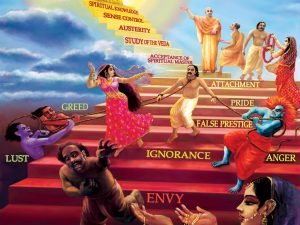
BG 16 | Godly vs. Ungodly (daiv-āsura-sampad-vibhāga-yoga)
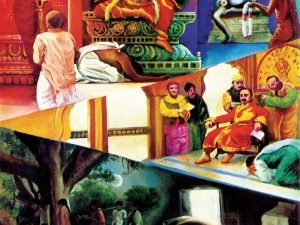
BG 17 | Threefold Faith (śraddhā-traya-vibhāga-yoga)